


12 Best Fraction Games for Children to Play
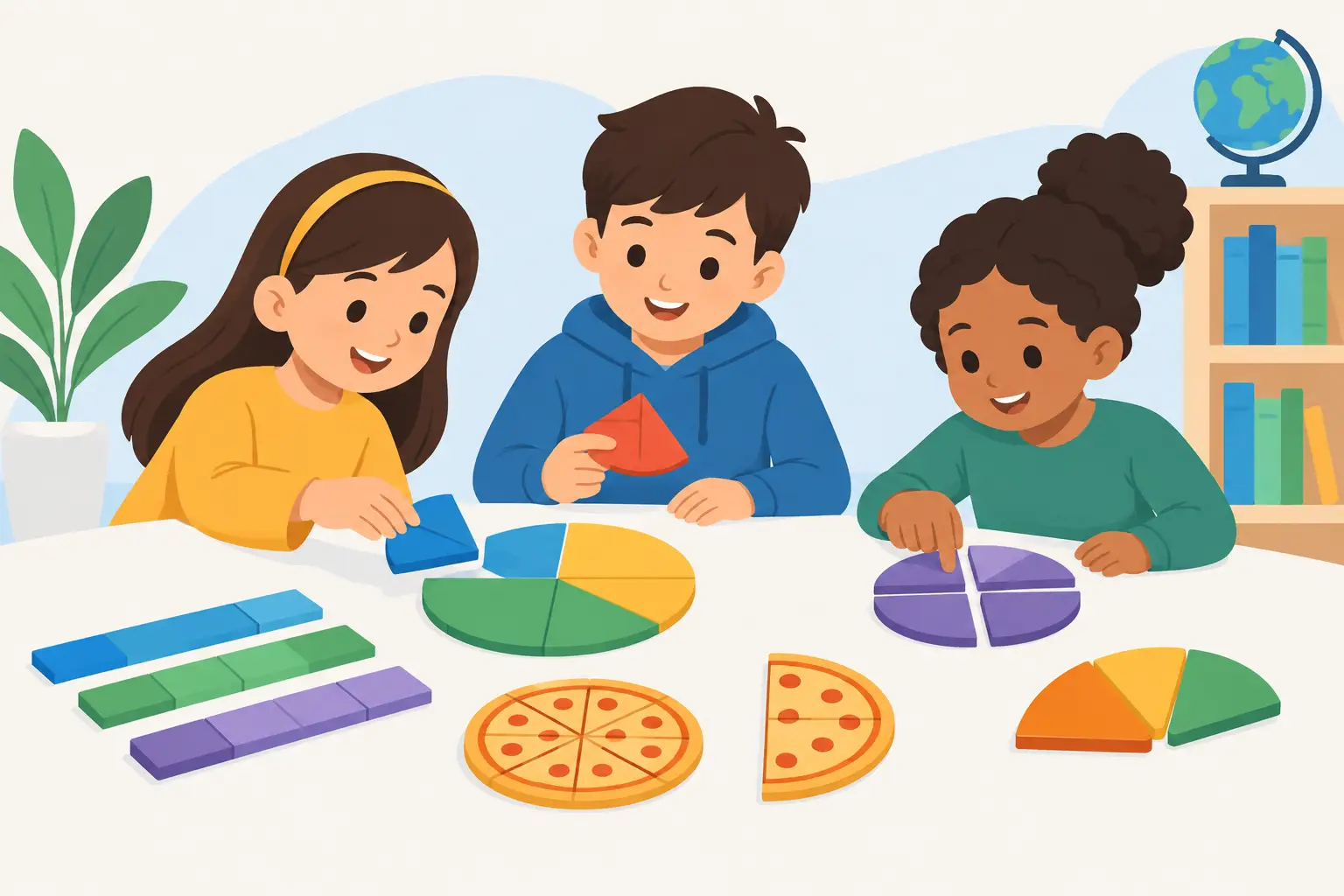
A child who freezes at the sight of 3/4 is not failing math. Often, they simply have not had enough chances to see what that fraction means in a real, hands-on way. The best fraction games children can play turn abstract symbols into pizza slices, card matches, movement, conversation, and small victories that say, “I can do this.”
For families, tutors, teachers, and volunteers, games can make fraction practice feel less like a test and more like an invitation. They are especially helpful when a child has begun to believe that math is only for other people. A simple game can interrupt that story and replace it with confidence.
Why Fraction Games Matter
Fractions ask children to hold several ideas at once. They need to understand that a whole can be divided into equal parts, that the bottom number tells how many equal parts there are, and that the top number tells how many parts are being counted. Later, they must compare fractions, find equivalent fractions, and connect fractions to decimals and everyday measurements.
That is a lot to absorb from a worksheet alone. Games give children repeated practice without repeating the same feeling of pressure. When they build one whole with fraction pieces or race to match 1/2 with 2/4, they can see the relationship before they are asked to explain it.
This matters because confidence and learning are connected. A child who feels safe making a mistake is more likely to try another strategy, ask a question, and keep going. At You’re All That Inc., we believe every child deserves learning experiences that build skills and self-belief at the same time.
What Makes the Best Fraction Games for Children?
A strong fraction game does not need expensive materials, a tablet, or a complicated set of rules. The most useful games make fractions visible, offer enough challenge to keep children engaged, and give adults a chance to notice where support is needed.
Choose games that match the child’s current understanding. A second grader may need to name halves and fourths with pictures, while an older elementary or middle school student may be ready to compare unlike denominators or add fractions with common denominators. Starting too far ahead can turn play into frustration. Starting with an easy success creates momentum.
It also helps to use familiar contexts. Food, money, music, sports, art, and measuring can make fractions feel relevant. If a child loves basketball, talk about making 3 out of 4 shots. If they enjoy baking, let them measure half and quarter cups. The math is still rigorous, but the entry point feels welcoming.
12 Fraction Games That Build Real Understanding
1. Fraction Pizza Shop
Draw paper circles and cut them into halves, thirds, fourths, sixths, and eighths. Children take turns filling “customer orders” such as one whole pizza made from two halves or four fourths. For a bigger challenge, ask for combinations like 1/2 plus 1/4 plus 1/4.
The goal is not just to get the answer. Ask, “How do you know this makes one whole?” Hearing a child explain their thinking reveals far more than a correct answer alone.
2. Equivalent Fraction Memory
Make matching cards with equivalent fractions, such as 1/2 and 2/4, 3/4 and 6/8, or 1/3 and 2/6. Place all cards face down, then have players turn over two at a time to find a match.
This game works well because children begin to recognize that fractions can look different while representing the same amount. Start with picture cards if symbols alone feel too difficult.
3. Fraction War
Use a deck of fraction cards, either homemade or printed. Each player flips one card, and the larger fraction wins the round. Begin with fractions that have the same denominator, such as 2/5 and 4/5. Later, include equivalent fractions and unlike denominators.
When there is a disagreement, do not rush in with the answer. Encourage players to use fraction strips, a number line, or a drawing to prove which fraction is greater.
4. Build-a-Whole Relay
Place fraction pieces or cards at one end of a room and label several “whole” spaces at the other end. Children work in teams to collect pieces that combine to make one whole. A team might bring back two 1/2 cards, or one 1/2 card and two 1/4 cards.
Movement can help children who struggle to stay engaged at a table. Keep the focus cooperative when possible, especially for children who are still developing confidence.
5. Fraction Number Line Hop
Create a large number line on the floor with tape, paper, or chalk. Mark zero and one, then invite children to stand where they think 1/2, 1/4, 3/4, or 2/3 belongs. They can hop to the answer, then explain why it belongs there.
A number line helps children understand that fractions are numbers, not just pieces of a shape. This becomes especially valuable when they begin comparing fractions.
6. Recipe Rescue
Give children a simple pretend recipe with missing measurements. For example, a recipe may need 1 cup of flour, but the only scoop available is 1/4 cup. How many scoops are needed? Use real measuring cups when available, or paper models when they are not.
Recipe games connect fractions to a skill children may use throughout life. They also offer a natural way to talk about equal parts and repeated addition.
7. Roll, Draw, and Compare
Players roll a die twice to make a fraction. The first roll is the numerator and the second roll is the denominator. Each player draws their fraction, then compares it with the other player’s fraction.
Set one helpful rule: zero cannot be a denominator, and the numerator should not be larger than the denominator until children are ready to work with fractions greater than one. This keeps the game aligned with the skill being practiced.
8. Fraction Bingo
Create Bingo boards with fraction models, words, and symbols. Call out a fraction such as 3/4, and have children cover the matching representation. One square may show the symbol 3/4, while another shows a shape with three of four equal pieces shaded.
Fraction Bingo is easy to adapt for groups, tutoring sessions, after-school programs, and family math nights. It gives every child many chances to connect language, pictures, and numbers.
9. Fraction Scavenger Hunt
Ask children to find examples of fractions around them. A clock can show quarters of an hour. A package may list a half-cup serving. A window can be divided into sections. A group of crayons can be sorted by color to describe a fraction of the whole.
The best part of this game is that it teaches children to notice math beyond the classroom. Fractions become something they can spot and describe in their own environment.
10. Cover the Whole
Give each player a board representing one whole and a collection of fraction tiles or cards. Players take turns drawing a tile and placing it on their board. The first person to cover the whole exactly wins.
This game invites strategy. A child with three fourths may hope to draw one fourth, but they also begin to see that two eighths would work. That is equivalent-fraction thinking in action.
11. Fraction Art Gallery
Give children a shape divided into equal sections and ask them to create a design using specified fractions of different colors. For example, half the design might be blue, one fourth yellow, and one fourth red.
Display the finished work and let each child describe their fraction choices. Art can lower the stakes for children who are hesitant about math, while still asking them to use precise reasoning.
12. Guess My Fraction
One player chooses a fraction and gives clues: “I am greater than one half but less than one. My denominator is four.” Other players guess the fraction and explain their reasoning.
For older children, add clues about equivalent fractions, simplest form, or placement on a number line. This game strengthens math vocabulary and helps children learn that explaining an answer is part of doing math.
How Adults Can Make Game Time More Powerful
The game matters, but the conversation around it matters just as much. Instead of saying, “That’s wrong,” try asking, “Can you show me what you were thinking?” A wrong answer may reveal a misunderstanding that can be corrected with a picture, a fraction strip, or a new example.
Praise effort with specifics. “You kept trying different pieces until the whole was covered” is more meaningful than a quick “Good job.” It teaches children that persistence is a math skill, not just a personality trait.
Use competition carefully. Some children are energized by racing and winning, while others shut down when they lose repeatedly. Cooperative versions, partner challenges, and personal-best goals can preserve the fun without making anyone feel left behind.
Digital fraction games can be useful, particularly when they provide immediate feedback and visual models. Still, screens should not replace conversation and hands-on learning. A few paper circles, index cards, bottle caps, or measuring cups can create powerful practice at little or no cost.
Make Space for Math Confidence
Fraction games are not a shortcut around learning. They are a way into learning for children who need to touch it, see it, say it aloud, and try again. Ten focused minutes after school, during tutoring, or at the kitchen table can grow into stronger number sense over time.
When a child proudly says, “Two fourths is the same as one half,” pause and celebrate the moment. That understanding is more than an answer on a page. It is evidence that, with encouragement and opportunity, they are building the confidence to keep learning.