


How to Teach Multiplication Arrays With Confidence
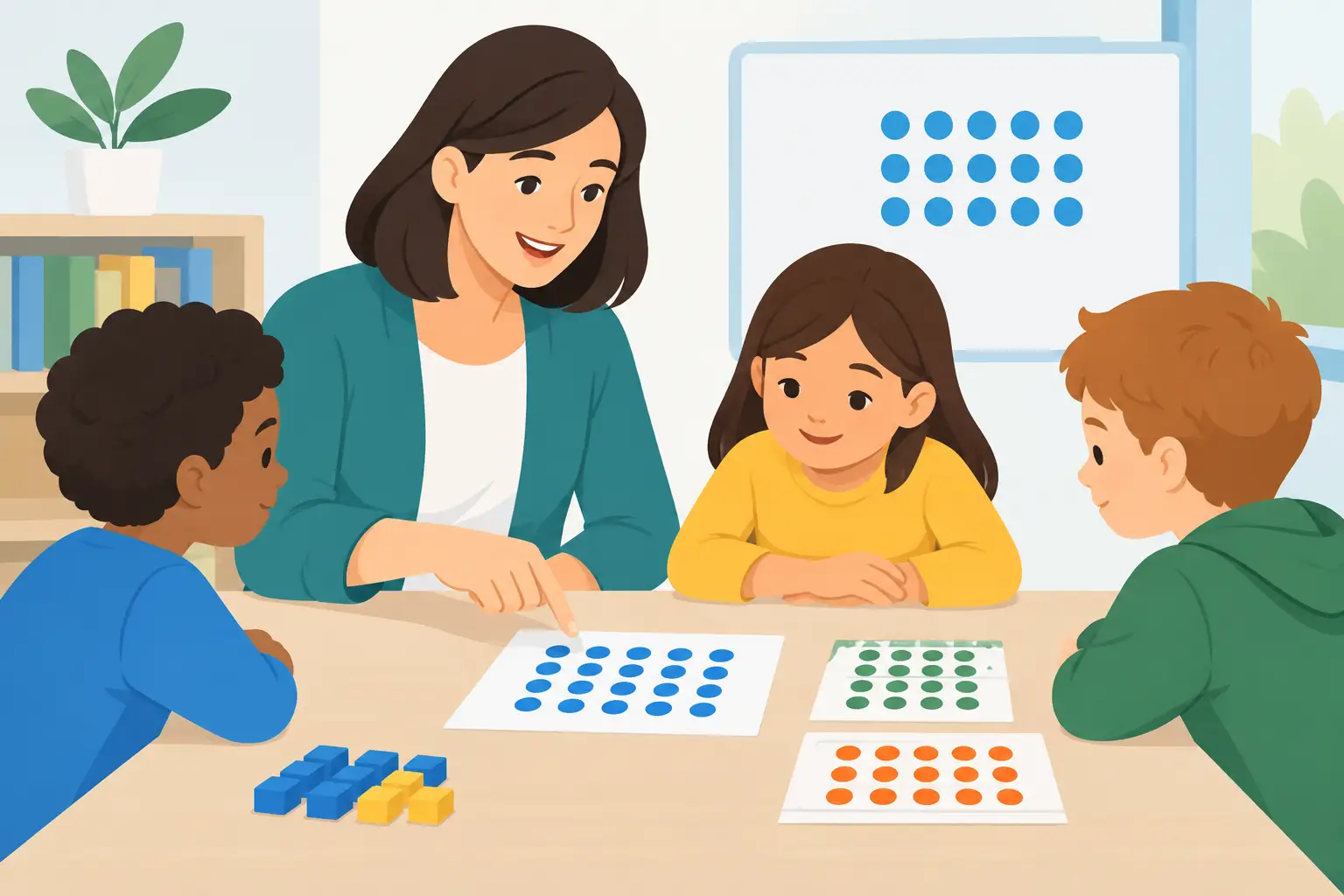
A child who says, “I don’t know my times tables,” may be closer to understanding multiplication than they realize. Put 12 buttons into 3 equal rows of 4, and the math becomes something they can see, touch, count, and explain. That is the power of arrays.
When families, tutors, and teachers teach multiplication arrays, they give children more than a trick for finding answers. They give them a picture of how multiplication works. For students who have felt discouraged by pages of facts to memorize, that picture can be the first step toward believing, “I can do math.”
What Is a Multiplication Array?
A multiplication array is an organized arrangement of objects in equal rows and equal columns. If a child places 15 counters in 3 rows with 5 counters in each row, they have created an array for 3 × 5 = 15.
It helps to use language consistently. The rows go across. The columns go up and down. In the example above, a child can say, “I have 3 rows of 5,” then write 3 × 5 = 15. They can also see 5 columns of 3 and write 5 × 3 = 15.
That second observation matters. It introduces the commutative property in a child-friendly way: switching the order of the factors does not change the total. Three groups of five and five groups of three both make 15. The arrangement looks different when turned, but the number of objects stays the same.
Arrays are especially useful because they connect several ideas at once: equal groups, repeated addition, multiplication facts, division, and later, area. A child is not simply being asked to remember that 6 × 4 equals 24. They can build six rows of four, count the total, and understand why the answer is 24.
How to Teach Multiplication Arrays Step by Step
Start with objects a child can move
You do not need special materials. Dry beans, bottle caps, coins, small blocks, crayons, cereal pieces, or squares drawn on paper can all work. If supplies are limited, a pencil and graph paper are enough. The goal is not a polished activity. The goal is making equal rows visible.
Begin with a small fact, such as 2 × 4. Ask the child to make 2 rows with 4 objects in each row. Give them time to arrange the objects. Then ask, “How many are in each row?” and “How many rows do you have?”
Have them count the total: 4, 8. Next, write the matching equation together: 2 × 4 = 8. Repeat the words out loud: “Two rows of four equals eight.” This verbal connection helps children attach meaning to the symbols.
Avoid giving a large set of facts all at once. A student who is still learning to make equal rows may feel overwhelmed by a 12 × 12 chart. Begin with facts they can build comfortably, often through fives and tens, then grow from there.
Connect the array to repeated addition
Before multiplication feels automatic, repeated addition gives students a familiar bridge. With a 3 × 4 array, point to each row and write:
3 × 4 = 4 + 4 + 4 = 12
Then ask the child what changed when they wrote the multiplication sentence. Help them notice that multiplication is a shorter way to describe equal-sized groups. It is not a separate mystery they have to memorize.
Some children will count every object one by one at first. That is okay. Counting is evidence that they are working. Over time, encourage skip-counting by the number in each row: 4, 8, 12. The shift from counting each object to counting groups is an important moment of growth.
Turn the array and talk about what stays the same
Once a child has built 3 rows of 4, ask them to rotate the arrangement or rebuild it as 4 rows of 3. Let them compare both arrays before supplying the answer.
You might say, “Does the total change when we turn it?” The child can count and discover that 3 × 4 and 4 × 3 both equal 12. This is more memorable than simply telling them that multiplication can be reversed.
Still, do not rush past the language. In a story problem, 3 bags with 4 apples each is different from 4 bags with 3 apples each, even though both totals are 12. The answer is the same, but the situation changes. Helping children describe the groups builds stronger mathematical thinking.
Use Everyday Questions to Make Arrays Matter
Arrays are already part of children’s lives. An egg carton, a muffin tray, a classroom seating chart, rows of windows, and tiles on a floor all offer opportunities to notice equal rows and columns.
At snack time, arrange 18 crackers into 3 rows of 6. Ask how many crackers there are without counting them one at a time. When setting the table, ask how many forks are needed for 4 tables with 3 seats each. During a walk, notice a brick pattern and estimate the number of bricks in a small section.
These moments should feel like invitations, not surprise tests. If a child is tired, hungry, or frustrated, save the math talk for another time. Children learn best when they feel safe enough to try, make a mistake, and try again.
Draw arrays when objects are not practical
After children build arrays with objects, move to drawing them. A rectangle divided into equal squares is a useful visual model:
```text □ □ □ □ □ □ □ □ □ □ □ □ ```
This shows 3 rows of 4, or 12 squares altogether. Ask the child to label the rows, columns, multiplication sentence, and repeated-addition sentence. Drawing helps students carry the idea into homework, quizzes, and situations where counters are not available.
For older elementary students, arrays can also make harder facts less intimidating. To solve 7 × 6, a child might build or draw 5 × 6 and 2 × 6, then combine them: 30 + 12 = 42. This strategy shows that a large fact can be broken into facts they already know.
Common Sticking Points When You Teach Multiplication Arrays
One common challenge is unequal rows. A child may place four counters in one row and five in another, then call it an array. Rather than saying, “That’s wrong,” ask, “Do all the groups have the same amount?” Let them adjust the model and see why equal groups are necessary for multiplication.
Another challenge is confusing the number of rows with the total number of objects. Keep returning to simple questions: “How many rows?” “How many in each row?” “How many altogether?” This steady wording creates a reliable routine.
Some students understand arrays but still struggle to recall facts quickly. That does not mean arrays failed. Understanding and fluency grow together, but at different speeds. Continue using visual models while practicing a few facts regularly. A child should not be pushed to memorize facts before they have a way to make sense of them.
It also depends on the child’s age and needs. Kindergarten and first-grade learners may focus mostly on making equal groups and adding. Second- through fourth-grade students may use arrays to learn multiplication and division facts. Older students can use rectangular arrays to explore area and break apart larger numbers. The same model grows with the learner.
Build Confidence Through Conversation
The strongest array lessons include a child’s voice. Instead of asking only, “What is the answer?” try questions such as, “How do you know?” “Can you show it another way?” and “What would happen if we added one more row?” These questions honor the child’s thinking and reveal where support is needed.
Praise the strategy, not just the speed. “You made equal rows so clearly” tells a student what they did well. “You kept trying different arrangements” reinforces persistence. For children who have heard that they are not good at math, specific encouragement can change the way they approach the next problem.
Families, volunteers, and educators all have a role in making this practice possible. A few patient minutes with everyday objects can turn a confusing worksheet into a real idea. When children are given tools, time, and encouragement, math becomes less about guessing and more about reasoning.
Every array a child builds is a small reminder that learning has structure, support, and room to grow. Keep the counters nearby, keep the questions kind, and let each correct row become proof that they belong in the math conversation.